

Soutenance de thèse d’Olivier Béjean-Maillard
Olivier Béjean-Maillard soutiendra sa thèse intitulée « Simulating slow-moving landslides with AI: Multi-source data, hydro-meteorological forcings, and interpretability » le mercredi 11 mars 2026 à 14h, dans l‘amphithéâtre A du bâtiment Métrologie, situé au 16 Route de Gray à Besançon. Il sera possible de suivre en visioconférence après une prise de contact ().
Composition du jury
- M. Thom Bogaard ; Professeur ; Université de Delft (Pays-Bas) ; Rapporteur
- M. Filippo Catani ; Professeur ; Université de Padoue (Italie) ; Rapporteur
- Mme Anne Johannet ; Professeure ; IMT Mines Alès ; Examinatrice
- Mme Séverine Bernardie ; Ingénieure ; BRGM Orléans ; Examinatrice
- Mme Héloïse Cadet ; Ingénieure ; SAGE INGENIERIE Agence Isère ; Examinatrice
- M. Clément Hibert ; Physicien adjoint ; Université de Strasbourg ; Examinateur
- Mme Catherine Bertrand ; Professeure ; Université Marie et Louis Pasteur ; Directrice de thèse
- M. Jean-Philippe Malet ; Directeur de recherche CNRS ; Co-directeur de thèse
Résumé
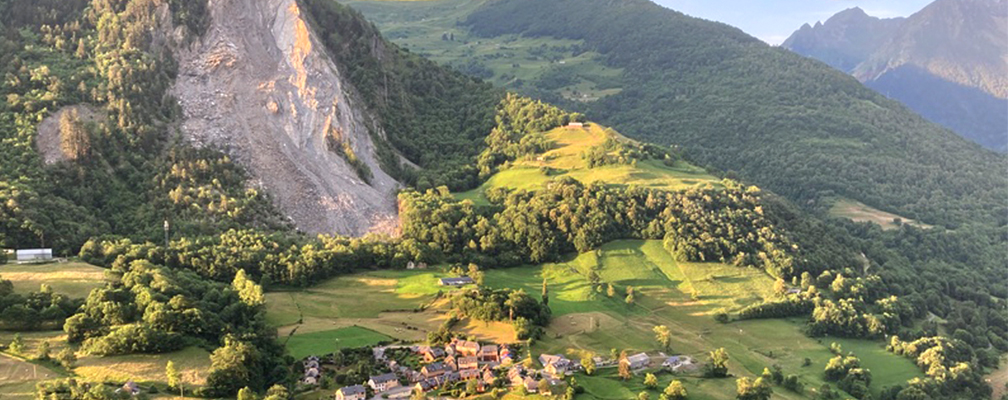
Slow‐moving landslides represent a significant hazard for populations and infrastructure worldwide. Yet, forecasting their velocity remains a major challenge because of the strong spatial and temporal heterogeneity of their internal properties. Their dynamics are nevertheless widely recognised as being strongly controlled by short- and long-term hydro-meteorological forcing. In this context, data-driven approaches, and in particular Artificial Intelligence (AI), provide an efficient alternative to physics-based models for capturing complex relationships between hydro-meteorological variables and landslide surface velocities. This thesis aims to better characterise and anticipate the dynamics of slow-moving landslides by combining long, multi-source time series with interpretable AI models. The objective is to propose a more generic framework for analysing the links between hydrometeorological forcing and surface velocity, while identifying the dominant mechanisms at different time scales. The work is structured around three complementary axes. The first axis addresses the lack of in situ hydrogeological measurements by using conceptual tank-type hydrological modelling (KarstMod), calibrated on deep Alpine landslides, to reproduce outlet discharge and to provide synthetic time series representative of internal storage. The second axis consists in developing a scalable eXplainable AI (XAI) framework, from data preprocessing to velocity simulation, based on XGBoost and SHAP interpretation. This framework is used to simulate velocity and to quantify the influence of hydro-meteorological variables from multivariate records acquired on several instrumented landslides. Finally, the third axis evaluates the effect of contrasting hydro-meteorological conditions by coupling rainfall and piezometric scenario generators with the trained models, in order to characterise the interannual variability and the evolution of the probabilities of monthly velocities over a hydrological year. These contributions improve the transparency of hydro-meteorological controls on displacement by providing a scalable methodological framework and operational tools for analysing slow-moving landslides. Ultimately, these approaches may evolve in line with advances in data acquisition, performance and explainability of AI models, in order to further integrate the spatio-temporal dimension and enhance their applicability in regions with limited, or absent, monitoring.